From Lancashire to Lowell: A Journey Woven in Cotton and Courage

How the Medley and Rawlinson Families Escaped the Lancashire Cotton Famine for a New Life in Massachusetts


The story of my ancestors is woven into two continents and shaped by one of the most unexpected consequences of the American Civil War: the collapse of the British cotton industry. In the early 1870s, the Medley family of Oldham and the Rawlinsons of Chorley — both towns in Lancashire, England — left behind everything they had known. Their families had suffered deeply during the Lancashire Cotton Famine, a humanitarian crisis triggered when the war across the Atlantic severed the global cotton supply chain. In search of food, work, and a future, they emigrated to Lowell, Massachusetts, where the cotton mills of the United States were gaining power and momentum just as Britain’s were falling silent.

Boomtown Lancashire

By the 1850s, Lancashire had become the industrial heart of the British Empire. The region thrived on cotton. It spun and wove raw fiber from across the globe into finished cloth that was exported to every corner of the British colonial world. Towns like Oldham, where the Medley family lived, and Chorley, home to the Rawlinson family, were part of this vast manufacturing network. More than 2,600 cotton mills operated across Lancashire, employing over 440,000 workers — many of them women and children.

The economy was strong, and work was plentiful. Families lived in modest comfort, supported by generations of textile expertise. For working-class families in mid-19th century England, Lancashire was a place of opportunity.
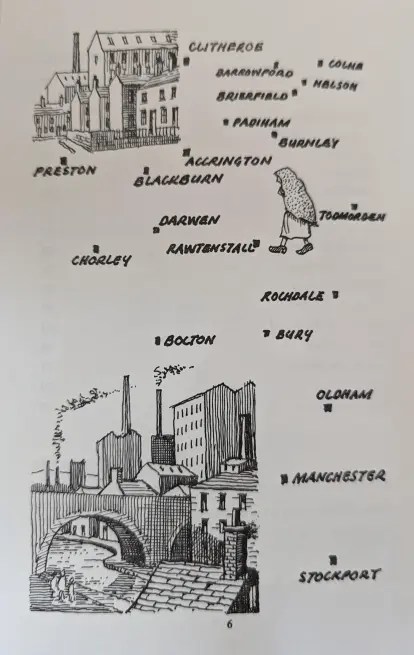
Lancashire Mill Towns

The Collapse: 1861–1865

But that prosperity came with a risk: dependence. Nearly 80% of the raw cotton used in British mills came from the southern United States. When the American Civil War erupted in 1861, Union forces blockaded Confederate ports, cutting off cotton exports to Britain almost overnight. What followed was a slow-burning disaster.

Mills began to shut down. Spindles stopped turning. By early 1862, hundreds of thousands of workers were unemployed. Whole communities were thrown into sudden poverty. This period became known as the Lancashire Cotton Famine — a term that obscures just how widespread and brutal the suffering was.

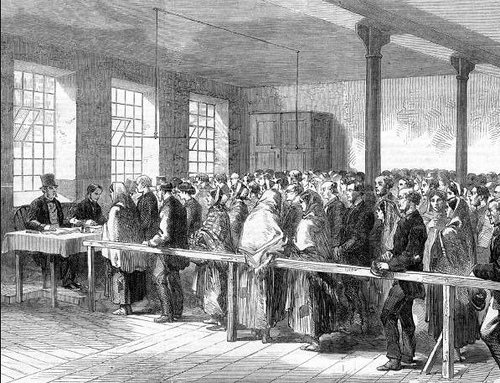
Local governments and charities tried to respond. Soup kitchens were opened. Sewing classes and public-works projects were created to provide relief. But these efforts were patchwork solutions to a global supply chain collapse. Reports from the time describe once-proud families pawning their possessions, burning their furniture to stay warm, lining up for food, and watching their children waste away from hunger.

The Medleys were among them. Two of their children died during this period — casualties of malnutrition in a country that, despite its wealth, could not feed them.
An 1862 newspaper illustration showing people queueing for food and coal tickets during the Cotton Famine.

Shifting the Looms: America on the Rise

While Lancashire suffered, something else was happening in America. Though the South’s cotton fields were locked in war, the Northern textile industry — particularly in New England — was evolving. Towns like Lowell, Massachusetts, had long been home to early American mills, but by the 1860s and 1870s, they were growing in scale and sophistication.

Rather than depend on enslaved labor or imported cotton, the American North diversified its supply and innovated its manufacturing methods. The Civil War accelerated mechanization and infrastructure development. In the post-war years, the U.S. began producing its own textiles on a much larger scale — and it needed workers.

Mill agents scouted Europe, especially the skilled textile towns of Lancashire, for people who could operate the complex machinery of modern factories. They offered wages, housing, and the promise of a better life — and for many desperate families, it was enough.

Leaving Lancashire Behind

The Medleys and Rawlinsons were among those who answered that call. With little left for them in England but loss, they boarded steamships bound for America. In steerage class, they made the crossing to a land they had only heard about — where cotton still spun, looms still turned, and children could grow up with more than a ration ticket.

In Lowell, they found steady work in the very mills that had, in part, risen due to the collapse of the British industry. Their skills translated, and they were able to rebuild. The irony, of course, is that their suffering during the Cotton Famine made them ideal candidates for the booming American textile economy.

Over time, they planted roots. Their names appeared in factory ledgers and U.S. census rolls. Children born in Lancashire became citizens of a new country. Their story — like that of so many working-class immigrant families — became one of resilience, adaptation, and renewal.
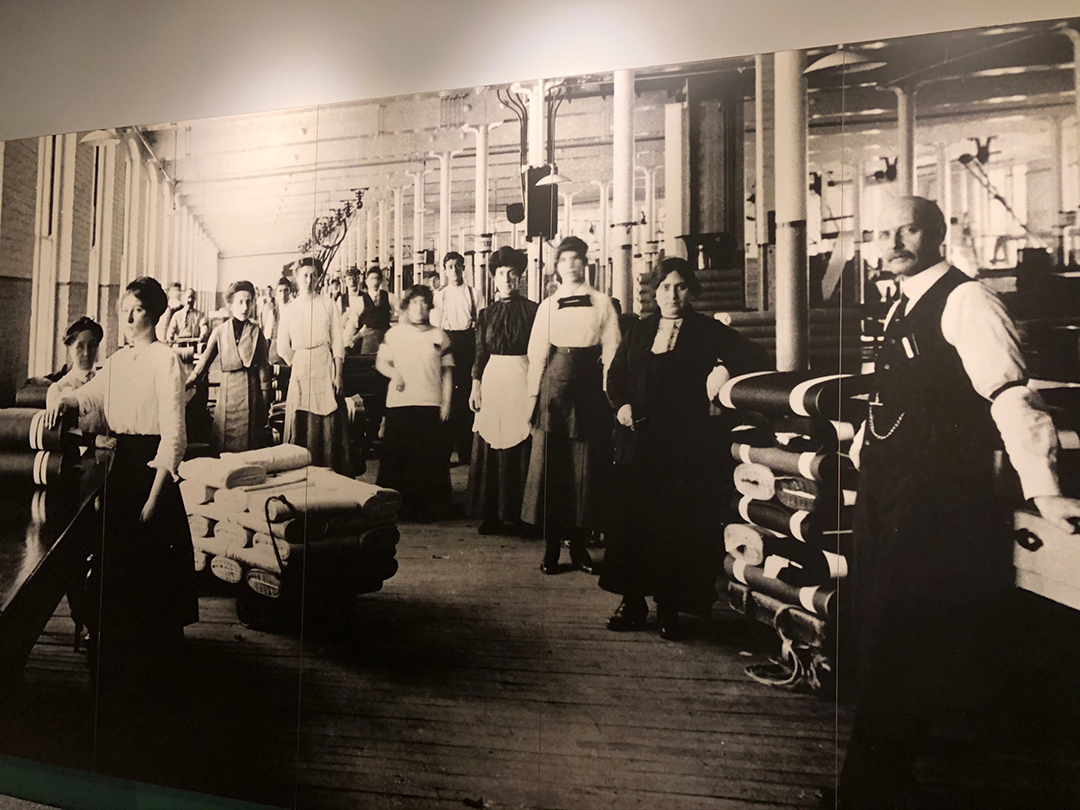
“Mill girls” inside a textile mill in Lowell, Massachusetts

History often focuses on generals and governments, but it is also lived quietly — in kitchens without food, in decisions made out of desperation, and in the quiet courage it takes to start over. The Medleys and Rawlinsons carried not only their grief but also their expertise across the sea. In Lowell, they found work. In time, they found stability. And through their journey, they stitched their place into the fabric of a different kind of empire — one made not of conquest, but of survival.


Personal details and descendants of Gravelina Medley and William Rawlinson (my great-grandparents)

Gravelina C. Medley Born: 28 May 1855, Oldham, Lancashire, England, to Joseph Medley (1806-1873) and Hannah Chambers (1813-1886). Gravelina emigrated from Liverpool, England and arrived at the port of Boston on 01 December 1870. She traveled with her parents in steerage class aboard the Siberia. Died: 20 February 1920 at Lowell, Massachusetts — a victim of the Spanish Flu Pandemic

William Rawlinson Born: 12 August 1843, Bolton, Lancashire, England, to John Rawlinson (1815-1865) and Esther Manley (1815-1862). William emigrated from Liverpool, England and arrived at the port of Boston in 1871. He became a naturalized US Citizen on 24 October 1884 at Lowell, Massachusetts. Died: 24 July 1925 at Lowell, Massachusetts

Marriage: 14 March 1874 at Lowell, Massachusetts, USA

Children of William Rawlinson and Gravelina Medley:

  • Lavina Rawlinson, 1875-1950; m. Irwin Leslie Prentiss, 1873-1926 
  • John William Rawlinson, 1877-1898
  • Edward Ernest Rawlinson, 1879-1950; m. Bessie Kate King, 1887-1955 (my grandparents)
  • Joseph H. Rawlinson, 1882-1906

Burial: Both Gravelina and William are interred at Edson Cemetery in Lowell, Massachusetts
12 Dozen Moccasins

A Girl, a Galley, and an Unwelcome Bargain

Long before she was a wife, a mother, or my great-grandmother, Emma Jane Attwood stood on the deck of a salt-scarred schooner. She was just thirteen, the Skipper’s daughter, and the cook for a crew of cod fishermen chasing fortune up the Labrador coast. It was a hard life, but it was hers—and after three summers onboard the schooner, she could expertly handle a swaying stove, salted fish, and the sharp tongue of any deck-hand. What she couldn’t have prepared for was the day an unexpected visitor tried to trade for her. The year was somewhere around 1905. This is a story passed down through salt and silence, stitched into the fabric of our family, as real as the sea itself.

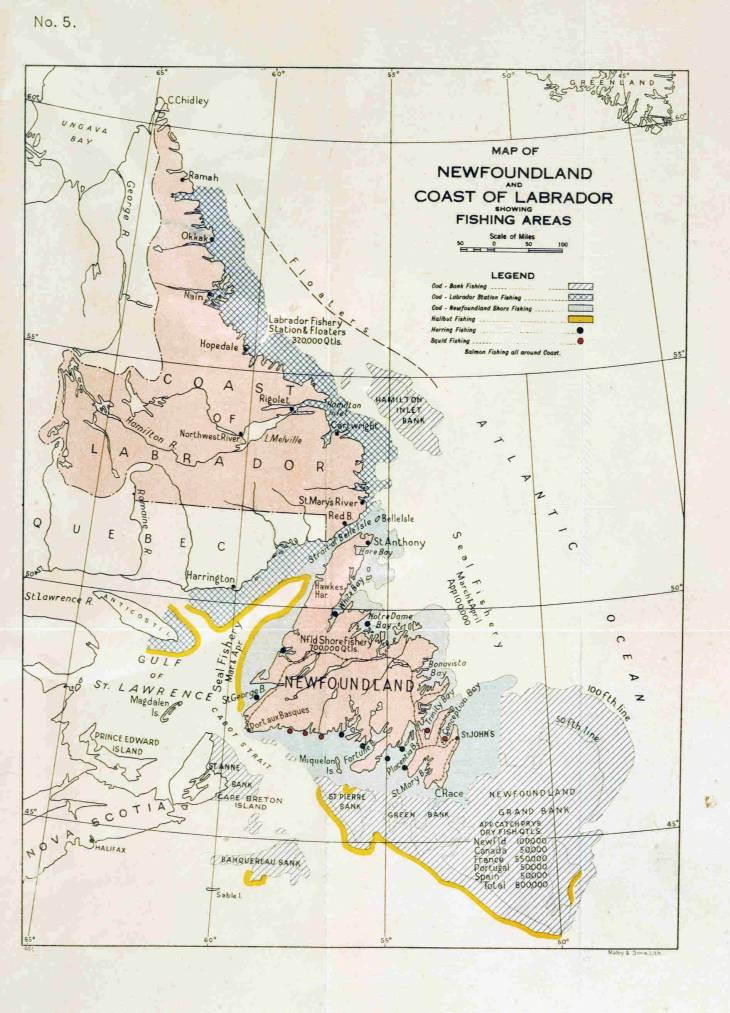
Emma was born in 1889 in Safe Harbour, Bonavista Bay, a rugged outport carved into the Newfoundland coastline. The Atlantic shaped everything there—weather, work, and will. Her father, “Skipper” Tom Attwood, captained the schooner “Parallel” that made the annual voyage north to the Labrador fishing grounds. Each summer, fleets of wooden boats left their home coves for the cold, rich waters where cod ran thick and the days stretched long. It was dangerous, relentless work.

Map of Newfoundland & Labrador showing the fishing grounds

Skipper Tom brought his young daughter aboard not as a novelty, but as the ship’s cook—a vital role. The galley was cramped, the stove barely steady in rough water, and the ingredients few. Emma cooked for men who hauled nets, salted fish, and patched sails day after day, far from home and comfort. She was a girl in a man’s world, and she earned her place with quiet grit and capable hands.

For three summers she sailed with her father and the crew, charting Labrador’s fog-laced coast. But everything changed the season an Inuk man paddled out to the anchored schooner.

He had seen Emma during an earlier visit, and, intrigued by her presence, asked about her. One of the crewmen—perhaps trying to be clever—joked that the girl could be “bought” for twelve dozen handmade moccasins.

The visitor left without a word. The crewman likely forgot his comment before the next tide turned.

Weeks later, the same man returned, his canoe heavy with beautifully crafted moccasins. Without ceremony, he tossed the footwear up onto the deck, piece by piece. Then he climbed aboard and calmly laid claim to the captain’s daughter.

Skipper Tom was stunned. In that moment, the line between cultures, customs, and intentions hung heavy in the air. He managed, through explanation and gesture, to return the moccasins and make it clear that his daughter was not for sale. The situation defused, but the damage—unspoken, unmeasured—was done.

That very night, under cover of darkness, the schooner slipped out of harbour and sailed on. Emma never again returned to the Labrador coast.

She would go on to live a remarkably long life—eventually settling in Ontario and passing away in 1993 at the age of 104. But that chapter of her youth, brief as it was, stayed in the family’s memory. A girl with salt in her hair and fire in her belly, doing a man’s work in a world that didn’t expect her there—and leaving behind a story as sharp and strange as the sea itself.

Emma Jane never sailed to Labrador again. Whatever words were exchanged between her father and the man who made the offer—or between Skipper Tom and the crewman who set it all in motion—have long since been swallowed by time and tide. But the story remains, worn smooth like sea glass, passed from tongue to tongue, generation to generation. In it, we find not just a glimpse of Emma’s youth, but the grit and grace of the women who came before us—women who knew the weight of salt air, the strength it takes to stand your ground, and the quiet power of slipping anchor and sailing on.


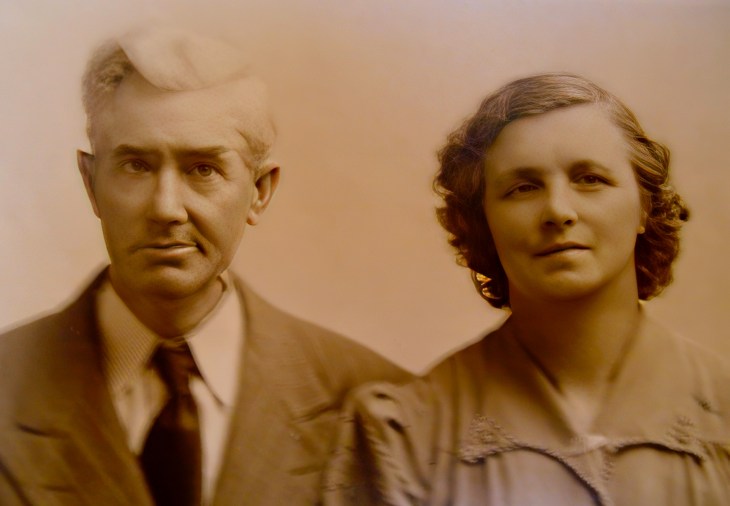
John Gill Davis & Emma Jane Attwood, circa 1910

Personal details and descendants of Emma Jane Attwood Davis (my great-grandmother)

Born: 27 January 1889, Safe Harbour, Bonavista Bay, Newfoundland, to Thomas Attwood (1864-1944) and Jochebed Rideout (1867-1944)

Marriage: 26 December 1907 to John Gill Davis(1882-1967) at Safe Harbour, Bonavista Bay, Newfoundland

Children with John Gill Davis:

  • Josephine Dot Davis {Dorothy}, 1911-1988; m. Percy Samson {Pearce}, 1903-1988 (my grandparents)
  • Minnie Bertha Davis, 1915-1916
  • Thomas Attwood Davis, 1920-2016; m. Margaret Penner, b. 1923
  • Kenneth Charles Davis, 1923-2017; m. Esther Hobden, 1922-2008
  • Edward Gladstone Davis, 1926-2018; m. Ann Kathleen O’Connor, 1920-2014
  • Ethel Irene Davis, 1929-2023; m. George Arthur Town, 1923-2011

Died: 19 February 1993 at Whitney, Ontario, Canada

Burial: 22 February 1993 at Union Cemetery in Oshawa, Ontario, Canada

The Tombstone Tells the Tale: John Ridout’s Path to Respectability

“At Newfoundland it is said that dried cod performs the office of money.” ~ Jean-Baptiste Say

In the cemetery at Cape Freels, Newfoundland, a weathered tombstone captures the remarkable story of John Ridout. Born in Bradford Abbas, Dorset, in 1793, John began life as a rural laborer. By 1812, he had deserted the Dorset Militia during the Napoleonic Wars, a choice that could have spelled disaster. Instead, he made his way to Newfoundland, where he transformed his life, becoming a respected member of his community. His journey reflects not only personal redemption but also the broader forces shaping the Atlantic world during one of history’s most tumultuous periods.


The Napoleonic Wars and Their Impact

The Napoleonic Wars (1803–1815) were a global conflict that engulfed Europe and its colonies. Britain, locked in a prolonged struggle against Napoleon’s French Empire, faced unprecedented demands on its population and resources. The British economy was heavily focused on the war effort, with industries and agriculture reoriented to support military campaigns. At the same time, a blockade imposed by France—the Continental System—sought to choke Britain’s trade routes and weaken its economy.

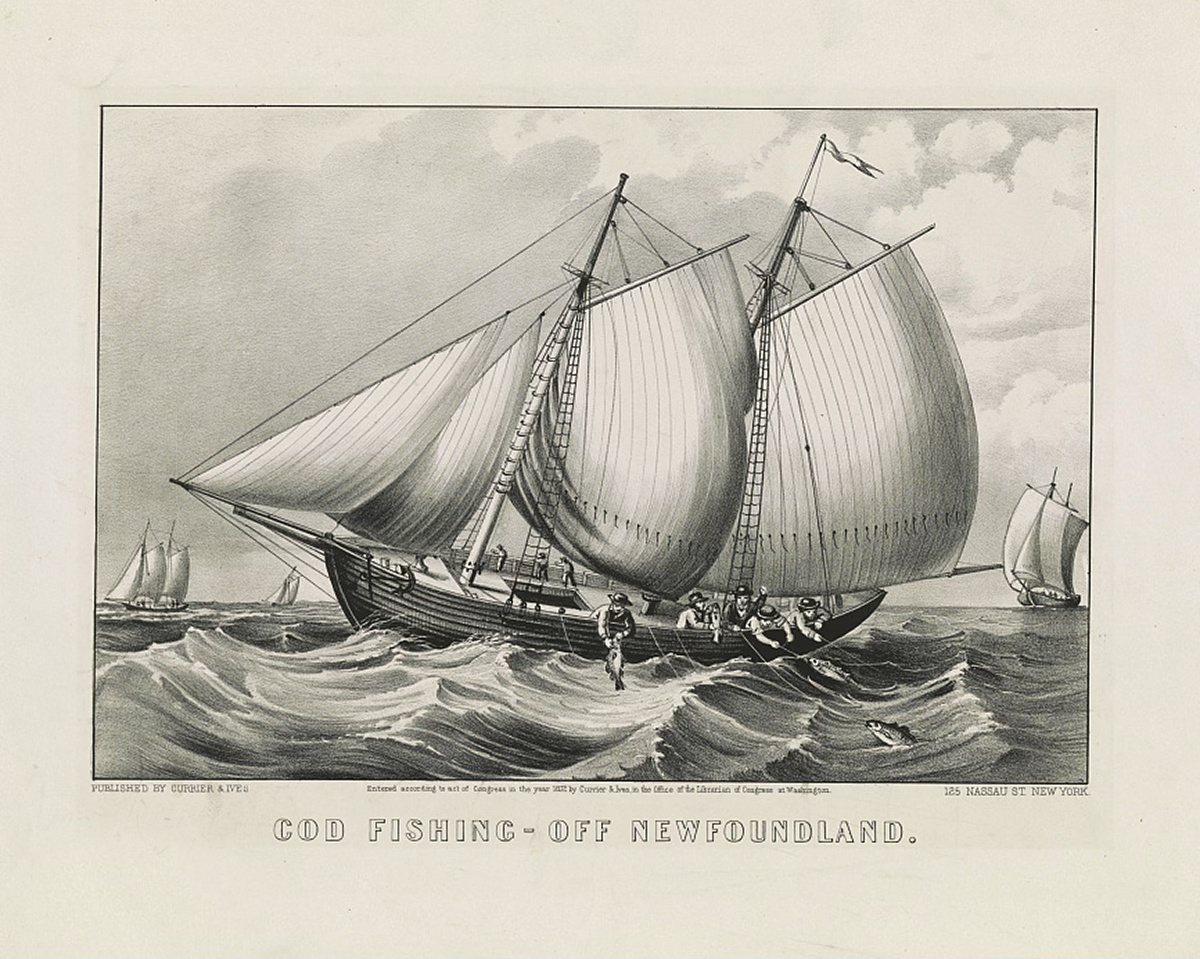
This disruption in European trade had a ripple effect across the Atlantic. With markets in Southern Europe and the Caribbean still accessible, Newfoundland’s cod fishery emerged as a vital link in Britain’s economic strategy. Salt cod, a durable and versatile food source, was exported to Catholic countries in Southern Europe, where dietary restrictions created high demand. The booming fishery provided much-needed revenue for Britain, even as war strained its homeland economy.

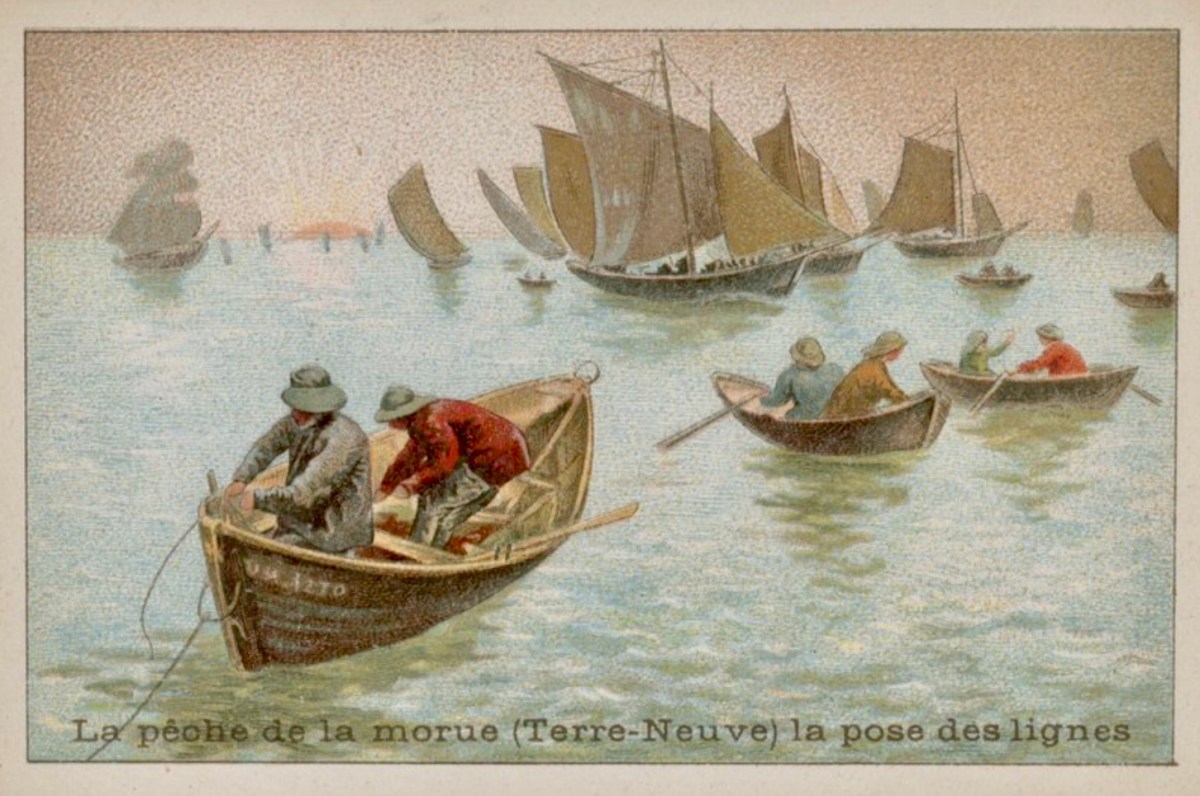
Cod Fishing – Off Newfoundland. Lithograph published by Currier & Ives

Why Men Deserted: John Ridout’s Escape

Against this backdrop, life in rural England was harsh. For laborers like John Ridout, economic opportunities were limited, and the demand for manpower in the military further destabilized communities. The militia, intended for home defense, was populated through a ballot system that forced men into service. While it was preferable to regular army duty, militia life was grueling, with low pay, long absences from home, and little chance for advancement.

Desertion, though a crime punishable by death, became a desperate choice for many. For John and his brother Peter, the booming Newfoundland economy must have appeared as a beacon of hope and the possibility of freedom outweighed the dangers. For men like John Ridout, military service offered little incentive to stay. In 1812, at the age of 19, John and his younger brother Peter deserted the Dorset Militia and fled England, settling at Middle Bill Cove on the northern edge of Bonavista Bay and joining a growing community of English emigrants drawn to the promise of prosperity in the cod fishery. A newspaper report in 1813 described them as “supposed to be in Newfoundland,” providing a glimpse of their escape. The notice detailed John’s physical characteristics: 5 feet 4 inches tall, with dark hair and eyes, a round face, and a fair complexion. This description, intended to aid his capture, paints a vivid picture of the young man who risked everything to start anew.

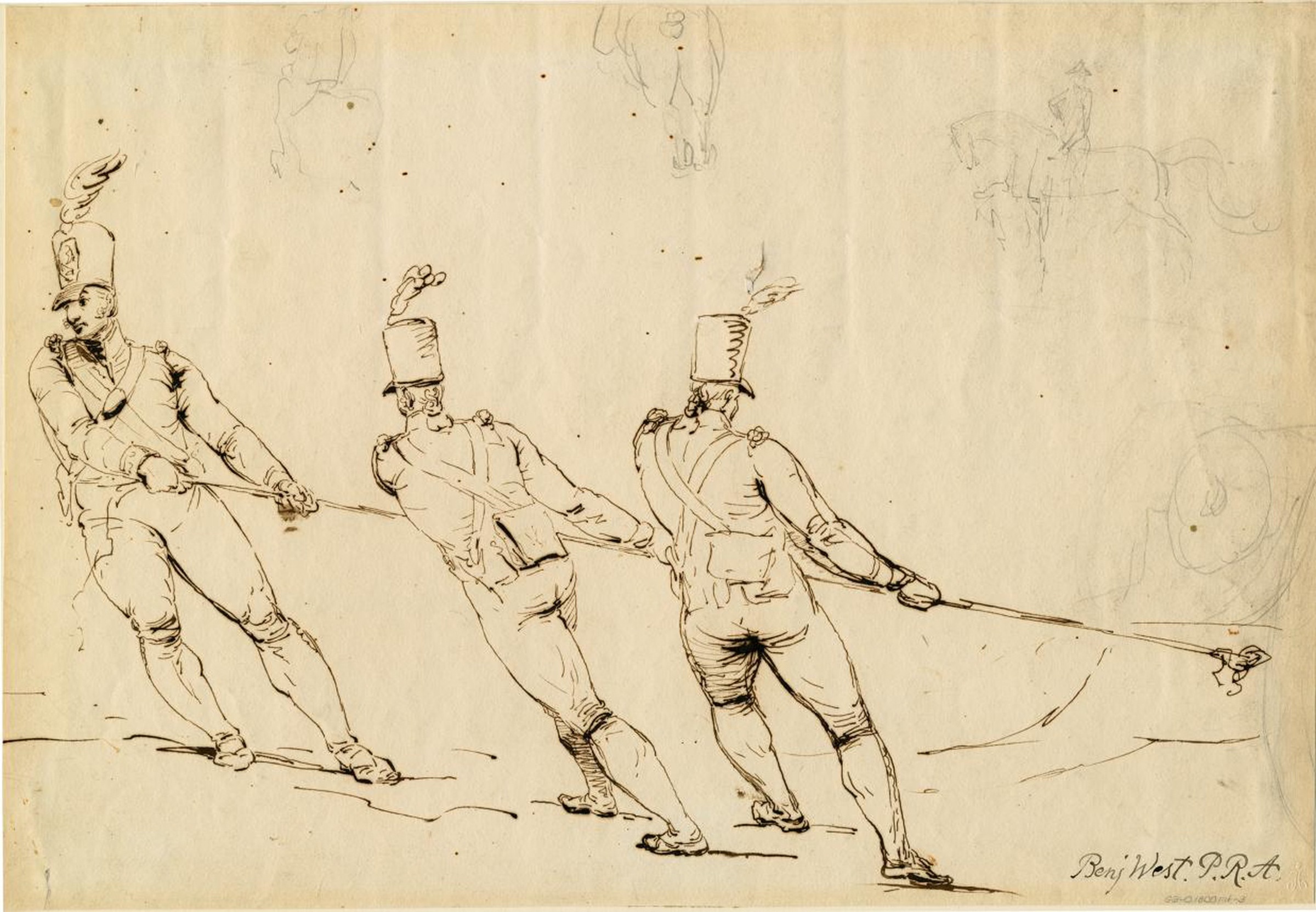
British Artillerymen Pulling a Gun, ink sketch by Benjamin West, circa 1800

Newfoundland’s Economy During the Napoleonic Wars

Newfoundland’s cod fishery thrived during this period, buoyed by Britain’s need for economic stability amid war. The fishery’s success was driven by a combination of geographic factors—proximity to rich fishing grounds—and economic necessity. With France attempting to disrupt British trade, Newfoundland became a critical supplier of fish to markets that remained open. The industry attracted workers from England’s West Country, including Dorset, Devon, and Cornwall, creating tightly knit communities abroad.

Life in Newfoundland was not easy. Harsh winters, grueling work on the water, and limited infrastructure tested the resilience of settlers. However, the promise of financial independence outweighed the risks for many, including the Ridout brothers.


Detail from an 1822 Admiralty Chart of Newfoundland from Trinity Harbor to Cape Freels

Building a New Life

By 1819, John Ridout had married Mary Penny and begun to build a life in Cape Freels, Newfoundland. Over the next four decades, John contributed to his community as a member of the local road commission and an active participant in church life. His efforts helped shape Cape Freels, connecting its residents to neighboring outports and fostering a sense of cohesion in an isolated environment.

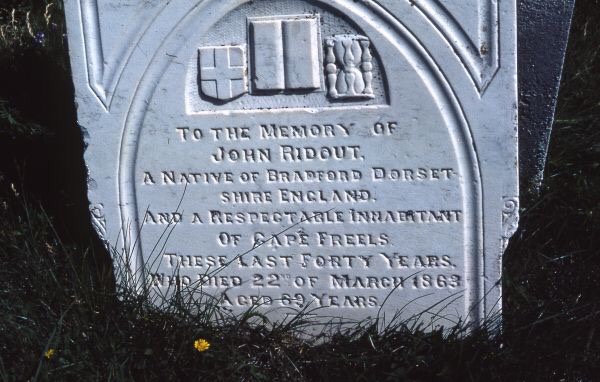
John’s transformation is memorialized in his tombstone at the Cape Freels United Church Cemetery:

“To the memory of John Ridout, a native of Bradford, Dorsetshire, England, and a respectable inhabitant of Cape Freels this last forty years, who died 22 March 1863 aged 69 years.”

The phrase “respectable inhabitant” underscores his redemption and the respect he earned over decades of hard work and community involvement.

Tombstone of John Ridout located at Cape Freels UC Cemetery

Desertion, Migration, and Redemption

John Ridout’s story is emblematic of the broader patterns of migration and economic opportunity during the Napoleonic era. The war created upheaval, but it also opened new avenues for those willing to take risks. Newfoundland, with its thriving cod fishery, provided a rare chance for financial stability and community. For John, leaving England and deserting the militia marked the beginning of a journey that ultimately led to a life of respectability.

His story reflects the resilience of those who sought better lives abroad and the complex interplay of war, economy, and migration that shaped the Atlantic world during the early 19th century.


Personal details and descendants of John Ridout (my 4th Great-Grandfather)

Born: 1 Nov 1793, Bradford Abbas, Dorset, England to John Ridout (1770-1829) and Anne Napper (1769-1803)

First Marriage: before 1819 to Mary Penny (1803-1836) at Middle Bill Cove, Bonavista Bay, Newfoundland

Children with Mary Penny:

  • Rennie Rideout, b. 1819
  • Susannah Rideout, 1822-1862; m. Jonas Humphries, 1800-1880
  • Margaret Rideout, b. 1824; m. Thomas Stokes, b. 1820
  • John Rideout, 1826-1903; m. Mary Ann Knee, 1831-1901 (my 3rd great-grandparents)
  • Mary Rideout, b. 1830
  • Peter Rideout, b. 1832
  • James Rideout, b. 1834; m. Mary Martyn

Second Marriage: 21 Nov 1839 to Anne May Hunt, at Cobbler’s Island, Bonavista Bay, Newfoundland

Children with Anne May Hunt

  • James Rideout, 1840-1890
  • Jacob Rideout, b. 1842

Died: 22 Mar 1863 at Cape Freels, Bonavista Bay, Newfoundland

Burial: Cape Freels United Church Cemetery, Bonavista Bay, Newfoundland

“Write what should not be forgotten.”

Frankly, I don’t enjoy writing. The process weighs on me…becoming laborious and generally  tiresome. Why then would I take on creating a blog?

“Write what should not be forgotten. ” ~ Isabel Allende

And thus you find me here as your guide to a story not of my own creation but that of the many individuals who came before to create and influence me….and perhaps you as well. I can think of nothing more worthy of preservation than family history for it is within that narrative that our traditions, our quirks and abilities, and our lifelong dreams make perfect sense and anchor us to the past…which should not be forgotten.

To my family members, welcome! May you find insight, entertaining histories, and answers to some of your questions.

To my fellow researchers, I hope we can share information and break down brick walls together. After all, if you have found this blog then there is a pretty good chance we are related!

Shall we begin?

My primary PATERNAL SURNAMES…(and general locations):

  • RAWLINSON (Dracut, Massachusetts/Chorley, Lancashire, England)
  • KING (Pictou, Nova Scotia)
  • CHAMBERS (Tatamagouche, Nova Scotia)
  • MATTATAL  (Tatamagouche and Lunenburg, Nova  Scotia/Montbéliard, France)
  • MEDLEY (Lowell, Massachusetts/Oldham, Lancashire, England)
  • MANLEY (Chorley, Lancashire, England)

My primary MATERNAL SURNAMES…(and general locations)

  • SAMSON (Flat Island, Bonavista Bay, Newfoundland)
  • DAVIS (Safe Harbour and Pinchard’s Island, Bonavista Bay, Newfoundland/Ringwood, Hampshire, England)
  • ATTWOOD (Safe Harbour, Bonavista Bay, Newfoundland)
  • RIDEOUT (Cape Freels, Bonavista Bay, Newfoundland/Bradford Abbas, Dorset, England)
  • GILL (Pinchard’s Island, Bonavista Bay, Newfoundland)

By all means, the list will expand! Please feel free to ask those burning questions, suggest topics of research, share additional information and pictures, or make notations about potentially incorrect information.

Thanks for following along!

~ NLR

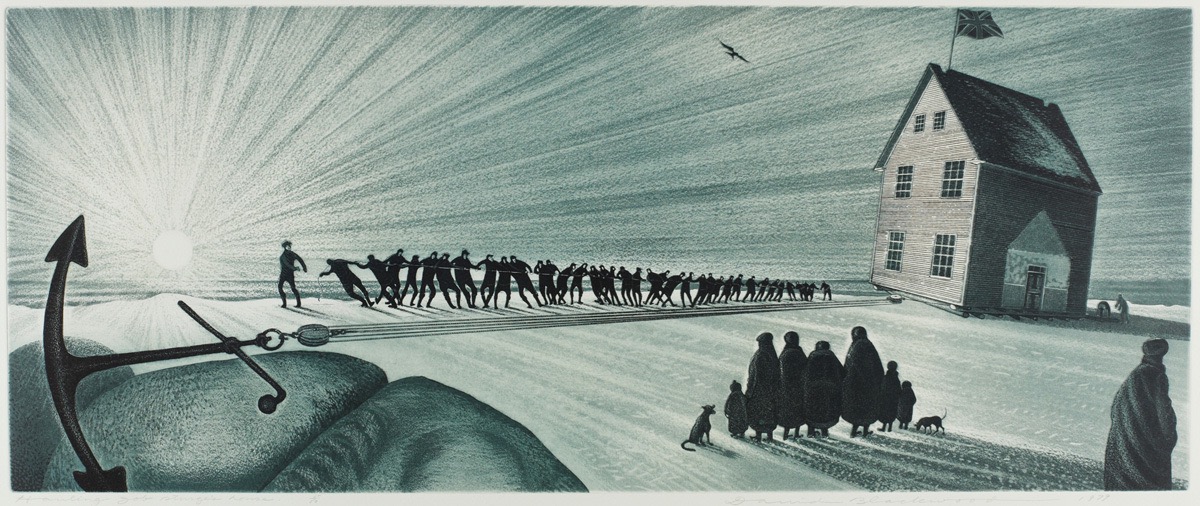
“Hauling Job Sturge’s House” by master printmaker David Blackwood, 1979.               (To whom I am related – my 3rd cousin 1x removed)